
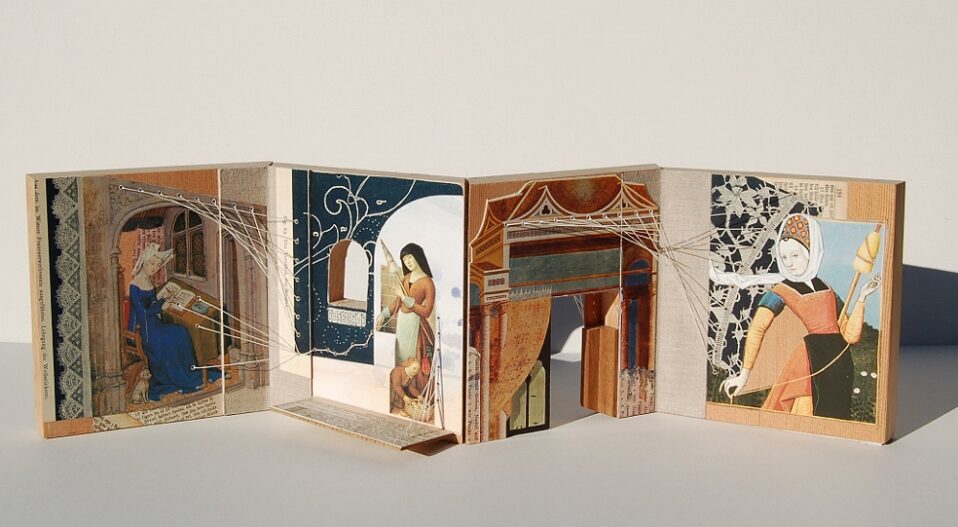
Flexible Thinking for Rigid Pages
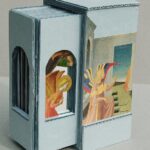
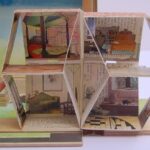
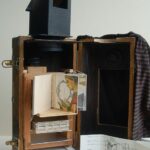
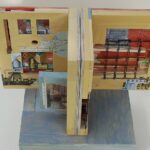
In this webinar Susan Collard will share different approaches to binding Board Books. Among the examples she’ll demonstrate are adhesive bindings using cloth, paper, and Tyvek; mechanical bindings using cabinet hinges and custom hardware; and sewn board structures. Additionally she will talk about the tools she uses and how to use them.
As a practicing architect, Susan thinks about books as spatial sequences rather than static objects. For her, an artist’s book is meant to be handled and experienced as a journey. She is especially interested in forms that suggest movement, unfolding, and discovery. Board books—particularly wooden books—offer strong possibilities for her work.
Board books’ rigid formats invite exploration, but their rigidity presents real challenges. Without the flexibility of paper, the geometry of page turns becomes unavoidable, page counts shrink, and the spine and cover need to be reconsidered. Susan sees these constraints not as limitations, but as tools that help define the structure and character of a book. “Pages” can be carved, drilled, hinged, cut, or built up into frames and boxes, allowing the book itself to become an object in space.
Join us in this exploration of Board Books.
About: Susan Collard is a book artist, architect, and writer who lives in Portland, Oregon. She received a Bachelor of Architecture from Cornell University, and an MFA in poetry from the University of Arizona, which is where she first encountered artists’ books. Since then, she has made dozens of one-of-a-kind books incorporating collage, unexpected materials, and adapted forms. Her books have been shown widely in juried and invitational exhibitions. She is best known for her books constructed from wood, a versatile material that invites the inclusion of glass, metal, stone, and other surprises. Many are housed in library collections, as well as the Bainbridge Island Museum of Art. Susan continues to earn her living as an architect, using her spatial sense, pragmatism, and listening skills in the cause of residential remodeling.