
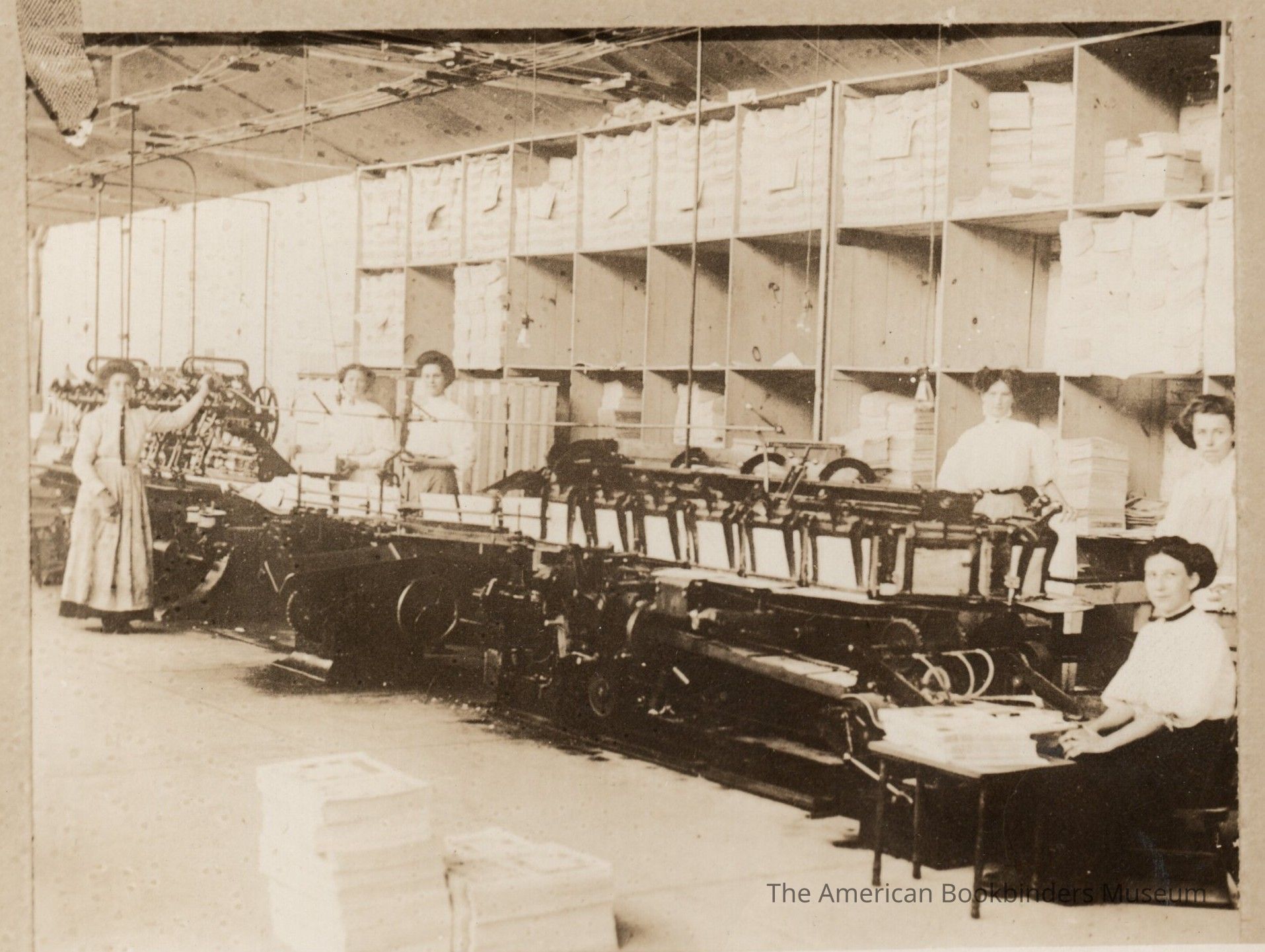
1910 DC Cook Installation of a George Juengst and Sons Collator/Stitcher and Covering Machine.


2025.4.10
Photocopy
This image is of the actual installation of a George Juengst and Sons Covering machine attached to an existing collator stitcher combination with (6) women in the view. The woman on the far left has her hand on the lever mechanism that would stop the machine. The woman seated on the far right would have kept the cover feeder full of stock. The other 4 women would feed the signatures into the collator and take the completed magazines off the coverer and pile them down to let the poor adhesives of the day, dry before they were fed by hand into a trimmer for cutting off the folds and final sizing of the magazine. Background: Existing machines in the trade prior to 1910 were intermittent in use, meaning they would not advance if a book was missing entering the covering machine or they were stand alone operations where product moved from one machine to the next by hand. Charles Juengst develops the idea in 1908 to create a continuous motion covering machine which he could couple to a collator and stitcher combination. The areas he needed to address were the creation of the hinge clamp design for his covering machine, this allows for a smooth flow of the stitched collated set into the clamp. He also needed to develop the means to inhibit the flow of adhesive for attaching the cover when there is no stitched book in the clamp or if the cover feeder misfired and no cover was present. He also needed to develop a cover breaker that moved in time with the clamp to provide the timing so the cover breaker could apply pressure, seal the cover to the adhesive and crease the cover, without ripping the book from the clamp. Charles Juengst had been at DC Cook in Elgin, IL, and he discussed his concept of this continuous coverer with the manager of the plant there a Mr. Topping in 1908. Juengst agrees to sell him the covering machine for a price not to exceed $4,000 ($135,000 2025 dollars). In July of 1909 Juengst ships his first coverer to DC Cook and installs it to a collator and stitcher, of Juengst’s design, at DC Cook previously in 1907. The machine was a success but because they made so many improvements along the way Juengst took the first machine back and dismantled it and replaced it with a new machine with all the improvements in 1912. This installation at DC Cook was the center piece of the trial between George Juengst and Sons VS Hill Publishing. TW & CB Sheridan had installed a coverer of their design onto a collator and stitcher combination at Hill Publishing and Juengst sued for infringement and eventually won on appeal in 1921. Dring the trial testimony Charles Juengst had stated that his concept of coupling these machines together was not only saving space, and creating higher net productivity at 3,500 books per hour, but it took less manpower to operate the machine. DC Cook had Sheridan machines without the coverer in line and it took 9 women to operate the line, but with his machine it should only take 4 women to operate the machine. You will notice in the original photo, which Juengst states was taken by an employee at DC Cook, it shows 6 women in the picture, but Juengst ran an ad in The Inland Printer in March of 1910 that used this very photo but two of the women were removed from the photo to make Juengst’s point of only needing 4 people to operate the system.
Sheridan Collection
4 in